
Award-Winning Automated Solar Panel Cleaner

The Lilypad: Floating Across a Solar Field
Yousif Alhajji and I had an idea: a specialized system of robots that could clean an entire solar field without anyone lifting a finger. That idea became the Lilypad, and it won us an award at the 2026 MassRobotics Form & Function Challenge, alongside the rest of Team Audentes: Wesley Cooke, Nathan Huang, Andres Permuy, Megha Venkatesam, and Kenneth D. Sebesta.
The problem
Solar prices have fallen steadily for two decades, but cleaning services haven't scaled to keep up. Today's options are crews driving around a large field with brushes or remote-controlled cleaners, or expensive permanent automated infrastructure. The machines that exist, crawler cleaners and linear sweepers, clean a panel row well, but neither can get from one set of panels to the next. For a job that only needs doing about once a month, that makes cleaning labor-intensive, expensive, and slow.
The idea: a carrier and a cleaner
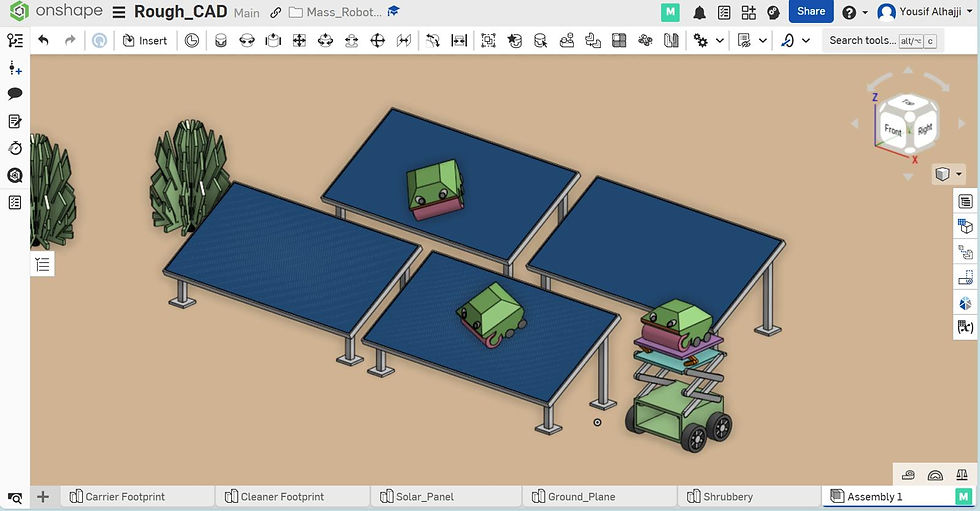
Yousif and I entered the MassRobotics Form & Function Challenge to tackle this, and we quickly landed on a two-robot system. A small cleaner robot handles the panel itself, and a larger carrier robot ferries it from row to row. Together they turn one cleaner into a whole-field solution, with no one walking the site. We also recognized that branding was important. We decided to give it a "Frog and Lilypad" aesthetic, as it was as though a cleaner robot was hopping from panel to panel, and all it needed was an extra "lilypad", the cleaner, to do so.

The carrier went through many iterations. Our early concept used a three-arm manipulator; the final Lilypad moved to in-hub motors, a modular frame, and a Stewart-Gough platform. We made a small mockup as shown below:
The Lilypad breaks down into four subsystems:
Drivetrain: a 1515 aluminum extrusion chassis driven by four repurposed hoverboard hub motors, with an AMD GMKtec mini PC as the compute and control hub for the whole system.
Scissor lift: rather than design a lift from scratch, we bought an off-the-shelf motorcycle jack and retrofitted it. We replaced its hand crank with a Maxon brushless motor and a Harmonic Drive gearbox, giving us an electrically actuated lift that raises the top platform so the system can reach high-mounted panels.
Stewart-Gough platform: a six-DOF platform that matches the panel's tilt so the cleaner can dock seamlessly against the side of a panel. We added passive compliance with deformable semi-ellipsoids inspired by Transcend's Deflex, so the platform adjusts itself on contact. We also used Maeden stretchable wiring so the moving joints wouldn't fatigue the cables. We affectionately called the full carrier CAD model the "LilyCAD."
Cleaner: the hero of the story, since the carrier has nothing to carry without it. The cleaner connects to a custom control panel over Bluetooth, with directional controls, an emergency stop, and mode selection. From there, it can be driven manually or switched into autonomous mode, where it uses computer vision to detect panel edges, pivot, and sweep row by row until the carrier collects it. A live-feed controller tracks both the cleaner's and the carrier's trajectories across the field, showing the cleaner sweeping each panel and the carrier moving it to the next.
The sponsors, and the people behind them
One of the best parts of the competition was who it put us in a room with. Maxon and Harmonic Drive didn't just supply the actuation for the scissor lift, they helped us with selecting a gearbox and designing adapters so that the scissor lift would integrate seamlessly with their hardware. Reynolds & Moore sat down with us for a safety assessment to pressure-test whether the Lilypad could operate safely at the scale of a real solar field. Their mantra, "Safety is an accelerator," really stuck with me.
The trip I remember most was the site visit to Mitsubishi Electric's facility in Vernon Hills, Illinois. We spoke with their engineers about human-robot collaboration and how a system like ours would need to fit into the infrastructure already on a solar site. Terrel Childs, the engineer who gave us a tour of the facility, was incredibly helpful in showing us a litany of sensing and safety options Mitsubishi uses every day. It was also the only time Yousif and I were in the same place during the whole design process.
We split the project between Purdue and Columbia, so a snowy day in Chicago, with a detour to the Field Museum, doubled as our one in-person design meeting, as shown below:

Getting to Boston & RASTIC
Getting to the competition was its own engineering challenge. Yousif took a cross-country train from Purdue to Boston, passing through NYC on the way, but we still didn't manage to meet up there. I had gone home first, so I took a bus from NYC to Boston, and it broke down on the highway. Below is the cargo I brought with me on the bus from New York to Boston!

We both made it, and under the stewardship of BU's RASTIC facility, we built the Lilypad system in 3 days. This included laser cutting, 3D printing, light machining, PCB design and in-house manufacturing, wiring flexible conductors to our sensors, live testing and debugging of all of our major subsystems, and finally, assembling the full devices.

At the competition
After three days of building at RASTIC, we wheeled the Lilypad onto the show floor in Boston's Seaport and set up next to our poster, with a "Boiler Up" sign flying for the Purdue half of the team. The neon green frog aesthetic caught the eye of many a passerby, and it was wonderful to talk to so many industry professionals about our idea and show off each of our actuators. We demoed each subsystem separately: the drivetrain, the scissor lift, the Stewart-Gough platform, and the cleaner. We walked a steady stream of visitors through the problem, from engineers and investors to other teams and the sponsors whose hardware was inside the robot. We also showed off this poster we made:

Partway through, one of the wheel mounts broke. We pulled a spare from our parts kit and swapped it right there on the floor, and the robot was back up and running. When they called our name, the whole team lost it. Months of late-night calls, CAD revisions, and cross-country logistics came to a head in one moment, and the Lilypad ended the night under a neon "Form & Function Winners 2026" sign.

The result
The Lilypad earned Team Audentes the 4th Place - Honorable Mention Award at the 2026 MassRobotics Form & Function Challenge, and our alma mater, Boston University, featured Yousif and me for the work: https://www.instagram.com/reel/DY5J0P1Ko2U/
That feature meant a lot to us, since BU's RASTIC facility is where the robot actually came together. More than the award, what I'm proudest of is how the project got built. Two of us started it with a sketch in a notebook, developed it across two universities nearly a thousand miles apart, met in person only once before the competition, and then assembled the whole system in three days and repaired it live on the show floor. The competition also put us in front of people we otherwise never would have met. Maxon and Harmonic Drive helped shape our actuation, Reynolds & Moore changed how I think about safety, and Mitsubishi Electric showed us what it would take for a system like ours to live on a real solar site.
The Lilypad started as an idea that a solar field shouldn't need a crew to stay clean. It became a working proof of concept and a reminder that the right partners, a good team, and a well-stocked spares kit can carry a small idea a long way.


Comments