
Diffusion Policy on Push-T and PPO on the Half-Cheetah

This project took two very different routes to a control policy: generating actions from demonstrations with a diffusion model, and learning from scratch with reinforcement learning.
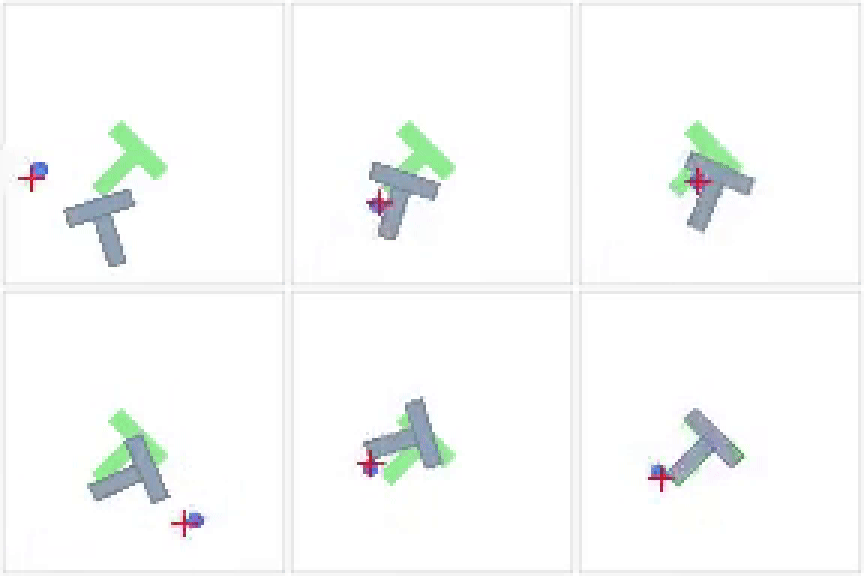
Diffusion Policy on Push-T. In Push-T, a circular agent must push a T-shaped block into a target pose, as shown in the final demonstration above. I implemented the core of a Denoising Diffusion Probabilistic Model: a cosine noise schedule, the forward noising process, and the reverse denoising loop used at inference. The policy is a 3.1M-parameter 1D conditional U-Net that looks at the last 2 observations, denoises a 16-step action sequence over 100 iterations, and executes 8 of those actions before replanning. Trained on human demonstrations, it averaged 0.93 target coverage across 10 randomized evaluation episodes, with a best episode of 0.98. The loss graph is below.

Diffusion works well here because pushing is multimodal: you can go around the block either way. A diffusion model can commit to one strategy instead of averaging two into a path that does neither.
PPO on the half-cheetah.
For the second half I trained a policy from scratch with Proximal Policy Optimization in Stable-Baselines3: 2 million environment steps across 8 parallel environments, with a 64-64 tanh actor and critic. My final run used a tight clip range of 0.08, a small entropy bonus of 0.0001, and a discount of 0.95 to keep credit assignment short-horizon. Below are my results.

Across 100 randomized episodes the policy averaged a penalized reward of 137, the highest average of any learned half-cheetah policy I trained this semester, ahead of both imitation policies. It also fell in 44 of those episodes, against 8 for behavior cloning. RL out-earned the demonstrations and paid for it in robustness. The system states are also shown below.

What I took from it. Imitation learning inherits the stability of its demonstrations; RL can exceed them but has to discover stability on its own. That trade-off, and the data that shapes it, is the part of robot learning I find most interesting.
Tools: PyTorch, Stable-Baselines3, MuJoCo (dm_control), Gym.


Comments