
Vision-Based Conveyor Sorting System

Industrial Automation, Columbia University | Spring 2026 Team: Andres Permuy, Maxime Mobayed, Maysarah Sukkar

The full prototype: camera gantry, conveyor, rack-and-pinion bin sorter, and control board.
Near the end of our Industrial Automation class, Maxime Mobayed, Andres Permuy, and I took on an extra credit project. In less than a week, we built a working proof of concept of a computer vision-enabled conveyor belt that detects, classifies, and sorts objects the way an industrial line would. We used found equipment, 3D-printed parts, and an Arduino.
The Problem
Recycling contamination adds billions of dollars a year in unnecessary costs to the U.S. waste system.
Manual sorting on material recovery lines is only about 60% accurate, and accuracy drops as workers get tired over a shift.
Our goal was to show that a small, low-cost system could close the full automation loop: detect → classify → decide → actuate, in real time.
Scope
The real-world target is material separation (plastic, metal, paper/cardboard).
For the prototype, we sorted geometric shapes instead. They exercise the same automation pipeline and let us focus on integration rather than material sensing.
Our original design also called for inductive, load cell, and NIR sensors. With less than a week available, we cut it down to vision plus the essential actuation.
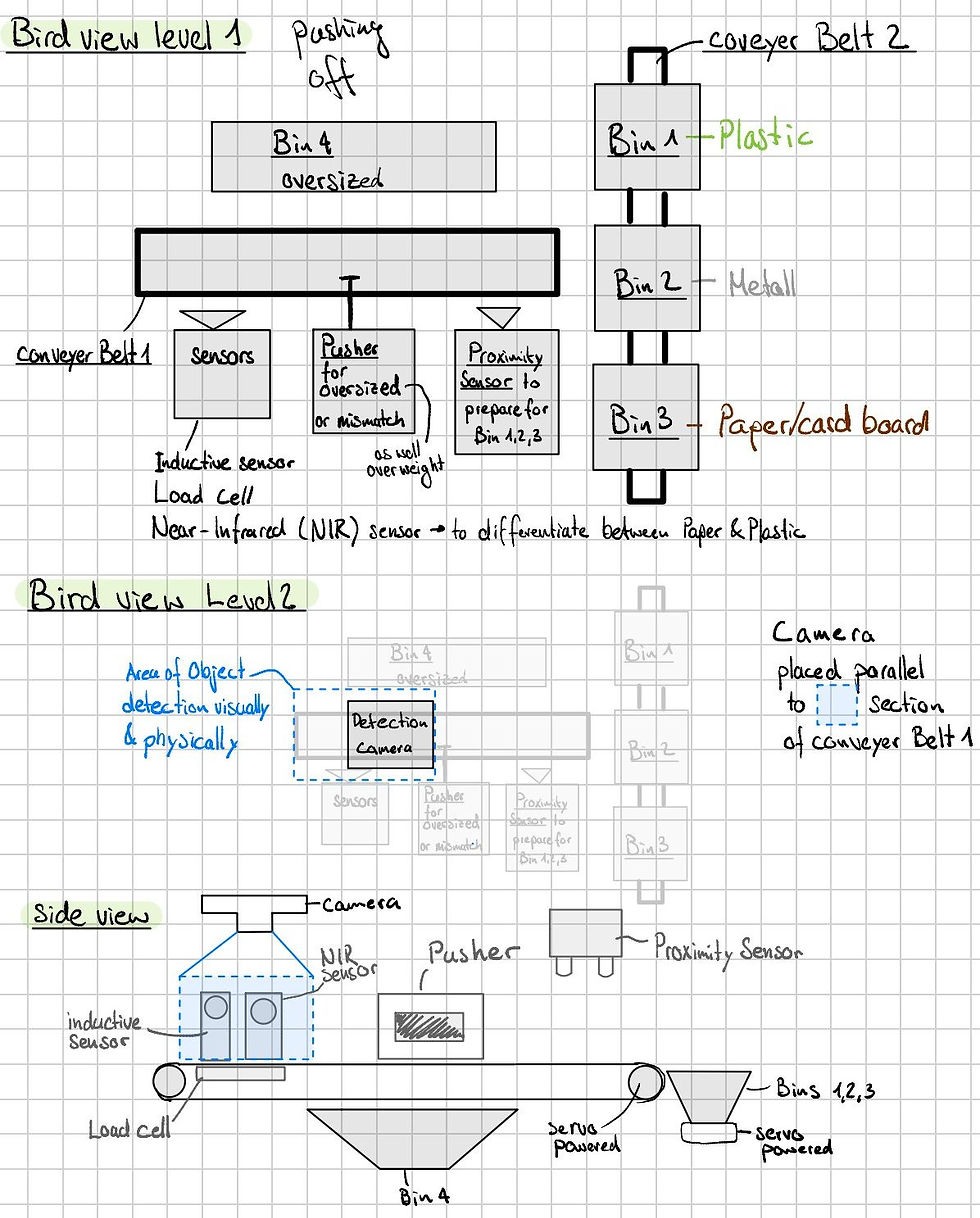
Original full-scope concept: sensor station, pusher for oversized items, and material bins for plastic, metal, and paper.
How It Works
Sense: A webcam on a 3D-printed gantry watches a region of interest on the belt. A laptop runs YOLO object detection, with frame-by-frame voting and a minimum-area threshold to reject noise.

Caption: Operator view: live feed with the conveyor ROI, last bin selected, and vote status, next to an overhead shot of the belt.
Decide: Classification results are sent to an Arduino, which runs event-driven, PLC-style logic in a read inputs → update logic → write outputs cycle.
Event | Trigger | Response |
Object detected | Rising-edge input | Start classification and run the belt |
Shape classified | Vision system data | Move the bin carriage to the correct bin |
Oversized object | Vision system data | Fire the pusher |
No object | Timeout or actuator feedback | Reset for the next object |
Manual stop | Ultrasonic sensor | Stop the conveyor and alert the operator |
Act:
A stepper motor drives the conveyor belt.
A 28BYJ-48 stepper moves a 3D-printed rack-and-pinion carriage with three bins, whose positions are hard-coded, to line up the correct bin under the belt.
A rack-driven pusher removes oversized objects.
Taped guide rails funnel objects toward the drop point.

Caption: Hand sketch of the rack-and-pinion bin sorter: three buckets on a stepper-driven rack.

Caption: The built version: guide rails funnel objects into the 3D-printed bin carriage.
Safety: An ultrasonic sensor acts as a manual stop. It halts the conveyor and alerts the operator.

Caption: Control board: Arduino, motor drivers, ultrasonic sensor, and cooling fan, all wired on a breadboard.
Architecture
The system is organized around the five-layer automation stack from class: field, control, intelligence, supervisory, and enterprise.
The layers are modular, so you can swap sensors, classifiers, and actuators without redesigning the whole system.
Results
The system sorted objects successfully from start to finish.
It was noisy, mainly because of poor lighting and a low-end camera with limited calibration options.
Classification was limited by using an off-the-shelf open-source model with no custom training.
What I'd Improve
Controlled lighting and a better camera with proper calibration.
A YOLO model trained on real recyclables.
Adding back the material sensors (inductive, load cell, NIR) for multi-modal classification.
Replacing the Arduino and breadboard wiring with proper industrial I/O or a real PLC.
Takeaway
Even a scrappy, week-long build showed that the full sense-decide-act loop can work with cheap hardware. The same architecture applies to recycling, packaging, quality control, and warehouse sorting.


Comments