
W.A.R. Machine: Omnidirectional Walking Assistive Robot

Team: Maysarah Sukkar, Lily Snow, Yousif Alhajji, Benjamin Pedi, Kaedin Kurtz Course: ME571 Medical Robotics, Boston University.
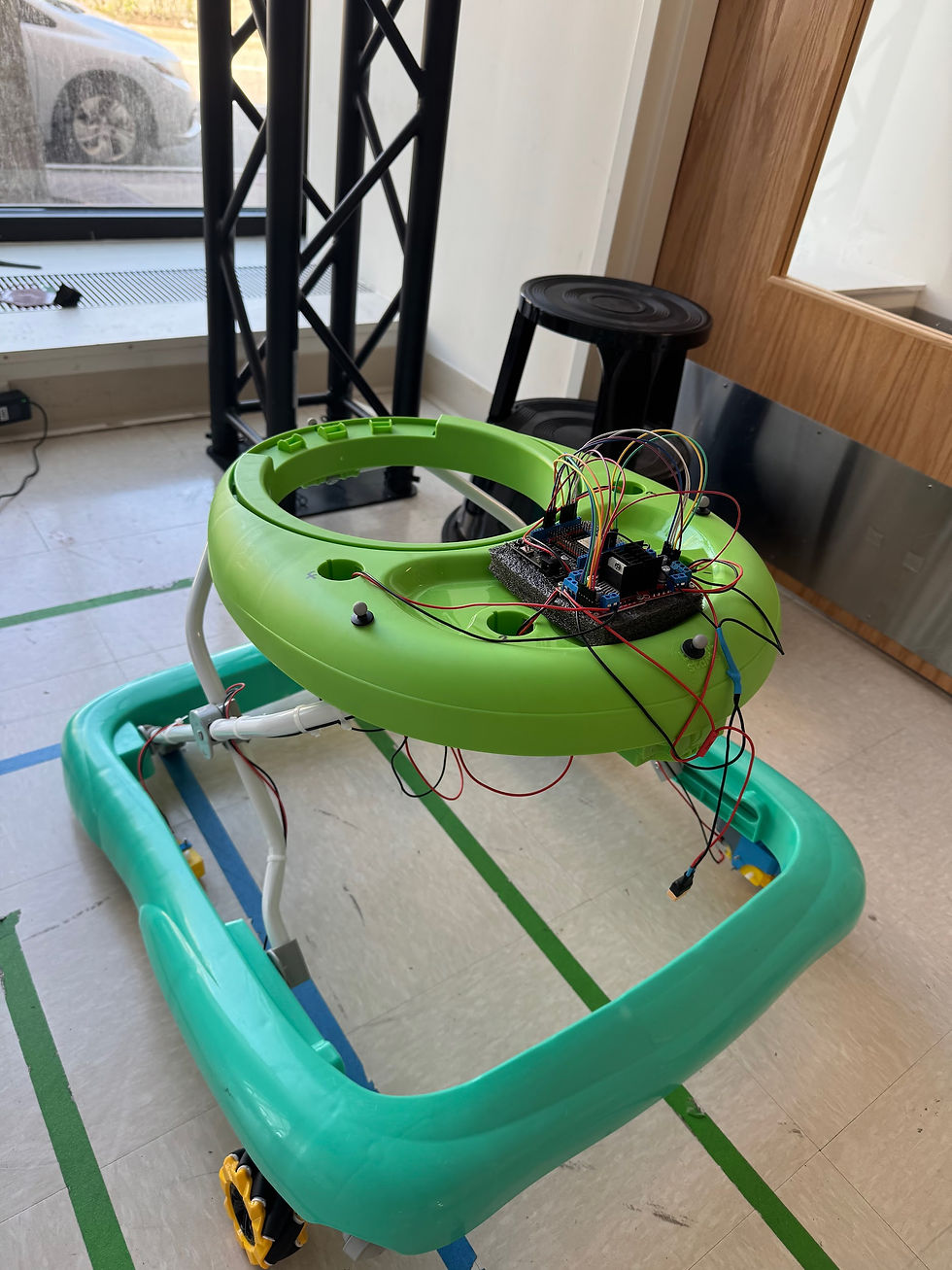
Overview
Body-weight-supported treadmill training helps patients relearn to walk after a spinal cord injury or stroke. These systems are expensive, clinic-bound, and limited to straight-line motion. They never train sidestepping or pivoting, which daily life requires. The Walking Assistive Robot is a scale proof of concept for a foldable, home-friendly alternative with holonomic (move-in-any-direction) motion.
System Design
Mobility: An infant-walker frame fitted with four mecanum-wheel DC motors on custom 3D-printed brackets, allowing movement in any direction.
Control: An ESP32-C3 drives the motors through two L298N motor drivers. A DualSense controller provides input: the right stick translates, the left stick rotates, and a shoulder button enables a slow mode for fine positioning.
Sensors:
Three force-sensitive resistors in the harness measure load on each leg and on the seat, showing how much the user relies on the device.
Motion-capture markers track the walker's full position and orientation.
Remote monitoring: The ESP32 streams force data over Wi-Fi to a live web dashboard with data logging, so a therapist can review sessions remotely.
Results
Force sensing: The FSRs responded quickly and clearly distinguished left-leaning from right-leaning.
Motion capture: The system consistently tracked the walker throughout BU's RASTIC facility.
NASA-TLX: Physical and mental demand were low. Effort and frustration came mostly from control setup. The detailed paper, presentation, and video demo are all below:
Next Steps
Replace the two speed settings with a continuous speed dial.
Add suspension for comfort over bumps.
Put motion-capture markers on the user to capture gait data.


Comments